The rules
How to play Iron & Ember
Two players, thirty life each. Bring the other player to zero and you win.
The table
The frontier runs across the middle of the table. Right behind it on your side is your creature row, where every creature you play stands and where all the fighting happens. Behind that is your terrain lane.
To play a card, drag it onto your half of the table. The game knows where it goes: creatures join the row and terrains go behind it.
Your deck
A deck is thirty-five cards, one copy of each. Creatures, spells and terrains all go in the same pile, in any mix you like.
Ember grows by itself every turn, so there are no resource cards to draw and no games lost to drawing the wrong ones. You play terrains because they help your board, not because you need them.
A deck has to be complete before you can play it.
The opening hand
You are dealt five cards. Pick any of them to send back for new ones: the first redraw is free. After that, each redraw sends back two cards or more and draws one fewer, down to a minimum of two.
A turn
- Your ember refills and grows. One more every turn, up to twenty.
- You can borrow half an ember from next turn. Spend it and your next turn starts half an ember short. Leave it and you keep it.
- You draw a card. Automatically, with nothing to press.
- Play whatever you can afford. Creatures go to the row, terrains go behind them, and spells take effect and then go to the graveyard.
- Declare your attacks, then strike.
- End your turn. Every wound on the table heals.
A creature can’t attack the turn it is played unless it has Impulse, and it attacks once per turn. If there is nothing left you can do, no card you can afford and no attack to make, the game passes for you after fifteen seconds so nobody sits waiting.
Combat: declare, then strike
Dragging a creature onto a target doesn’t start the fight. It declares an attack, and an arrow stays on the table to show what it will hit. Aim as many creatures as you want, then press Attack and everything lands at once.
Because it all happens at the same moment, a creature that dies in the clash still deals its damage, and three creatures ganging up on one target all hit, even if two would have been enough.
A defender hits back at full power against every attacker. Its damage isn’t split between them.
Pick a declared creature back up to cancel its attack. A creature only uses up its attack when it actually fights.
Damage and wounds
Every creature has a power and a defence. A hit that doesn’t kill leaves a wound: the card shows how much defence it has left, and the wound heals when the turn ends.
So damage adds up within a turn, never across turns. Two 3-damage spells in the same turn kill a creature with 6 defence. The same two spells a turn apart do nothing.
Terrains
Terrains sit behind your creatures and can never be destroyed. Spells can’t target them and attacks can’t reach them. A terrain is its faction’s home ground: it answers the creatures and spells of its faction that you play. An Echo goes off every time you play one, a Scheme counts them and goes off every few, an Upkeep acts at the start of each of your turns, and some simply make the creatures of their faction or family stronger for as long as they stand.
So terrains reward a deck that keeps to its faction. In a deck of exactly two factions, every terrain answers both. In a deck of three or more, a terrain answers only its own faction’s cards, which is the price of taking the best of everything.
Winning, and running out
Bring the other player to zero life and you win. There is a slower way too: once your deck is empty, you lose life at the start of each of your turns, one, then two, then three, and it keeps climbing. That is why Erode, which sends cards from the enemy’s deck to their graveyard, is a real way to win.
The forge
Every match you play to the end pays Ember Stones, win or lose, and stones are the only currency in the game. Spend them on card packs for the faction you are building, or on a card you already own to push it up the tiers.
Normal pays full price.
Empowered pays 80%.
Refined pays 60%.
Perfected pays 60% and carries one ability free.
An upgrade makes a card cheaper and never changes its power or defence, so you can always read exactly what your opponent’s creatures can do.
Reading a card
Everything a card does is printed on it, and the game does exactly what the card says.
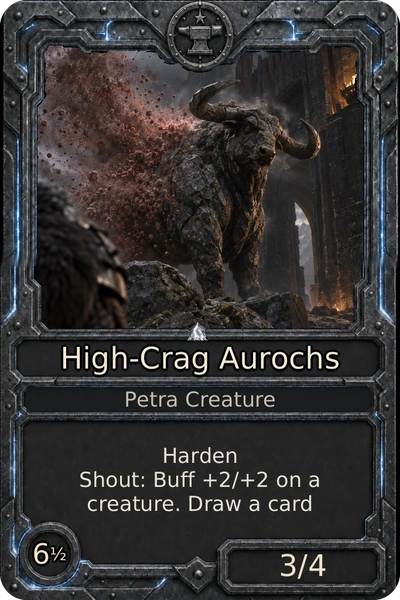
- The gem above the name is the card’s tier. White is Normal, blue is Empowered, yellow is Refined and red is Perfected. A higher tier makes a card cheaper and never changes its power or defence.
- The line under the name tells you what the card is: its family, its category and its type. This one is a Petra Beast Creature.
- The text box holds the card’s rules. Harden is an ability it always has. Shout is a moment: whatever comes after the colon happens when the card is played.
- The ember at the bottom left is what it costs. Seven here, then 5½ and 4 as you upgrade it.
- The numbers at the bottom right are power and defence, three and four. A wounded creature shows what it has left, and the wound heals at the end of the turn.
- The faction isn’t written anywhere. The metal, the colour and the crest at the top tell you this one is Anvil.
There are eleven abilities a creature can have, nine moments when a card can act, and a set of effects. The codex explains every one of them, the five starter decks are listed card by card, and the library has all 1,061 cards.
Common questions
- How many cards are in a deck?
- Thirty-five, one copy of each, terrains shuffled in among them.
- Is it free to play?
- Yes. A win pays five Ember Stones against another player and a card pack costs five, so a match you win is a pack of seven cards. A loss pays three. The bot pays a little less, more the harder it is, and a match you give up pays nothing. Real money only ever buys cosmetics.
- What is in a card pack?
- A card pack is seven cards: six around the outside and one in the middle that is never ordinary. A new account starts with fifty stones, which is ten packs before your first match.
- Do I have to draw a card each turn?
- No. The game draws for you.
- Can terrains be destroyed?
- No. Once a terrain is down, it stays down.
- What happens when my deck runs out?
- You lose life at the start of each of your turns: one, then two, then three, climbing every turn against your thirty life pool.
- Can I play against the computer?
- Yes, at four levels: Easy, Regular, Hard and Impossible. Hard plays two turns ahead for both sides and will punish your mistakes. Impossible is unfair on purpose: it goes first, starts with forty life and sees your hand.
- Does a higher tier hit harder?
- No. An upgrade lowers a card’s cost and never changes its power or defence, so an upgraded creature hits exactly as hard, for less ember.
- Can I build my own deck?
- Yes, right here on the site, with nothing to install. Click cards to add them, thirty-five cards make a deck, and the link at the top shares the whole deck with anyone.
- How many terrains can a deck hold?
- As many as you like. A deck is thirty-five cards in one pile, and how many of them are terrains is up to you.
- What can I play it on?
- It is coming to Windows, macOS and Linux through Steam, and to Android and iOS through Google Play and the App Store.
- Do I need an account?
- Yes. Your account holds your collection, your decks and your settings, so you are the same player on your phone and on your PC. Here is how to connect Google, Apple and Microsoft to it.
- Can I play with a friend?
- Yes. Press Play with a friend, create a lobby and give them its code, or type theirs and join: you are in the same match. Find an opponent pairs you with whoever else is waiting, and after a minute asks whether you would rather play a bot.
- Can I play offline?
- No. Every match runs on our server, against a person or a bot. That keeps every match fair and lets you replay it afterwards.
- Is there a single-player campaign?
- Not yet. For now there is the bot at four levels.
- What is an Alloy card?
- A card that belongs to two factions. It works fine on its own, and its second line switches on while you control a terrain from each of its two factions.
- How many cards are there?
- 1,061 cards, across five factions and 30 families, and every one of them has its own page on this site.
- What languages does it speak?
- It speaks 103 languages, the same list as Steam.
- Can I hear a card before I play it?
- Yes, on the card’s own page. Every card has its own sounds for when it lands, attacks and dies.